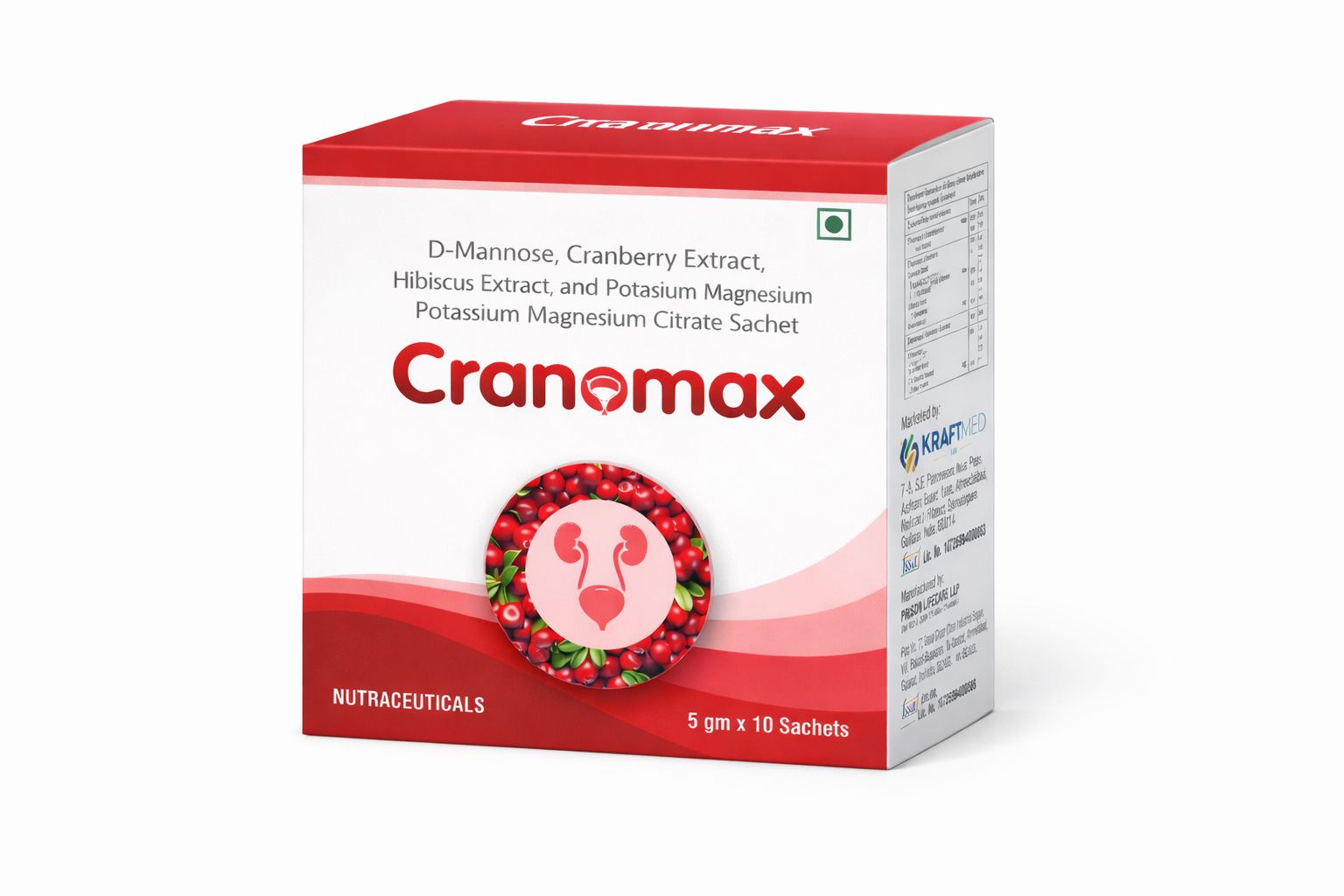
D-Mannose · Cranberry Extract · Hibiscus Extract · Potassium Magnesium Citrate · Dual-Pathway Defense
Antibiotics treat UTIs but can't prevent them. Cranomax targets the root cause — bacterial adhesion to the urinary tract wall — through two independent anti-adhesion mechanisms, giving comprehensive protection against recurrent uncomplicated UTIs.
D-Mannose competitively inhibits Type 1 fimbrial adhesion while Cranberry PAC-A prevents P-fimbriated bacteria from sticking. Together they block both major adhesion pathways — bacteria can't cause infection if they can't attach.
Most UTI supplements rely on just one mechanism. Cranomax blocks bacteria at two distinct attachment points simultaneously.
E. coli uses Type 1 fimbriae with FimH lectins to grip mannose receptors on urinary tract cells. D-Mannose floods the urine, saturating FimH — bacteria grip mannose in the urine instead of the bladder wall, and are flushed out on urination.
Type A proanthocyanidins from cranberry prevent P-fimbriated E. coli (a distinct adhesion pathway) from attaching to uroepithelial cells. Together with D-Mannose, this creates a complete dual anti-adhesion shield.
Rapidly absorbed and excreted unchanged in urine. Twice-daily dosing delivers 1.2g/day — exceeding the 1g/day clinically studied preventive dose. Achieves effective urinary concentrations for FimH competitive inhibition.
Standardized to 25% proanthocyanidins — delivering 112.5mg total PACs. ~30-35% are Type A PACs, providing ~36mg PAC-A per sachet: the clinically established anti-adhesion dose for recurrent UTI prevention.
Standardized to 20% polyphenols — delivering 50mg bioactive compounds. Clinical evidence supports 250-500mg/day for antimicrobial and anti-biofilm activity. Adjunct bacterial growth inhibition while maintaining tolerability.
Each ingredient in Cranomax is clinically dosed and serves a distinct, evidence-based role in urinary tract protection and comfort.
1.2g/day with twice-daily dosing. Exceeds minimum clinically studied dose. Rapidly absorbed, excreted unchanged in urine. Competitive FimH inhibitor — no antibiotic resistance risk.
Standardized by UV Method. Provides ~36mg Type A PACs — the clinically established dose. Prevents P-fimbriated E. coli adhesion independent of D-Mannose. Dual-pathway synergy.
Standardized by GV Method. Delivers 50mg bioactive compounds. Demonstrated antimicrobial and anti-biofilm activity in clinical studies. Adjunct to anti-adhesion protection.
~2g/day with twice-daily dosing — aligning with established urinary alkalization regimens. Modulates urinary pH, improves citrate levels, relieves dysuria, and maintains electrolyte safety.
Minimum clinical dose: 500mg/sachet (2×/day)
Clinically established anti-adhesion dose: 36mg PAC-A
Clinical range: 40-100mg polyphenols/day
Established alkalization regimen: ~2g/day
Every ingredient dosed to clinical evidence — not just label claims
| Feature | Cranomax | Standard Cranberry Capsule | Basic D-Mannose |
|---|---|---|---|
| Adhesion Pathways Blocked | ✓ Both (Type 1 + P-fimbrial) | P-fimbrial only | Type 1 only |
| D-Mannose Dose | 600mg (clinical) | None | Varies |
| PAC Standardization | ✓ 25% PAC (UV Method) | Often unstandardized | None |
| PAC-A Content | ~36mg (clinical dose) | Unknown | None |
| Hibiscus Anti-biofilm | ✓ 250mg standardized | None | None |
| Urinary pH Support | ✓ K-Mg Citrate (978mg) | None | None |
| Dysuria Relief | ✓ Yes (alkalization) | ✗ No | ✗ No |
| Antibiotic Resistance Risk | ✓ None (non-antibiotic) | ✓ None | ✓ None |
3+ UTIs per year? Cranomax's dual anti-adhesion mechanism interrupts the recurrence cycle without contributing to antibiotic resistance.
UTIs are more common and dangerous in pregnancy. D-Mannose and cranberry PAC-A provide safe, non-antibiotic preventive support throughout pregnancy.
Declining estrogen alters urinary tract microbiome and increases UTI risk. Cranomax provides non-hormonal preventive protection.
Patients and clinicians seeking to reduce antibiotic dependency. Cranomax works by blocking adhesion — no bacterial kill, no resistance development.
Catheter-related UTIs are a major clinical concern. D-Mannose provides preventive urinary tract protection in at-risk patients.
Potassium Magnesium Citrate alkalizes urine and relieves the burning sensation during urination — providing symptomatic relief alongside prevention.
Type 1 + P-fimbrial blocked simultaneously
The clinically established anti-adhesion dose
Non-antibiotic — bacteria can't adapt
Each clinically dosed per evidence